Customer Success at Ideals: Strategic focus and real autonomy
Great Customer Success roles are built through intentional culture, strategic client work, and genuine autonomy. With a growing number of clients, we’re expanding our team. I wanted to understand what makes CS here different.
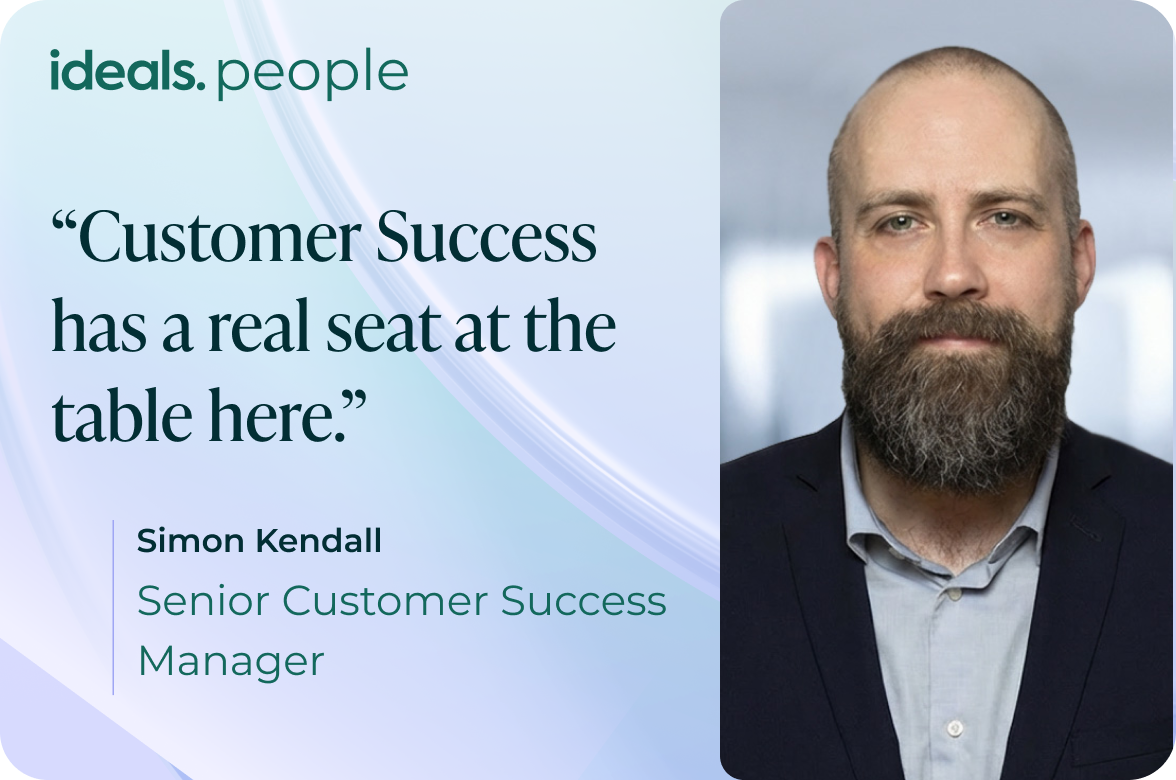
I sat down with Simon Kendall, our Senior Customer Success Manager (CSM) in the UK and recent Ideals Spotlight Award winner. We discussed what keeps experienced CS professionals engaged, how the role has evolved as we’ve scaled, and what it really takes to succeed when you’re managing 300+ enterprise accounts across global markets.
Watch a video recording of our conversation.
Q: Simon, thanks for taking the time today. Can you tell me a bit about your role at Ideals?
I’m a Senior CSM at Ideals. I’ve been with the company for around five years, and my role focuses on managing and growing relationships with a portfolio of enterprise and mid-market clients. That means working with organizations running high-value, high-stakes projects, often across multiple regions and stakeholder groups.
One of the things that’s changed a lot over the years is scale. When I started, I was managing a significantly larger number of accounts. But as the business has grown and matured, we’ve intentionally reduced portfolio sizes. Today, I’m closer to around 300 accounts, which allows us to go much deeper, be more strategic, and really focus on value rather than volume.
Where possible, I work with well-known brands across industries like finance, legal, and corporate development, which keeps things interesting and constantly challenging. Most of the work I do is in the UK, but we work cross-border, and we can be dealing with projects based in Europe, Africa, anywhere in the world, really.
The role is much less about ticket-based support and much more about long-term partnership.
Q: That sounds very interesting. How do you actually prioritize your time and attention across that quite wide range of clients?
You typically have a combination of high-touch strategic accounts alongside more self-sufficient customers. The key is being very intentional about where you spend your time.
I prioritize based on a few core signals: usage trends, upcoming renewals, expansion potential, and any change in stakeholder engagement. That tells me where proactive outreach is going to have the biggest impact versus where it’s about being more responsive.
On a weekly basis, I’m usually balancing onboarding for new customers, check-ins for key accounts, and renewal or expansion conversations. But it’s a proactive thing. You’re expected to plan ahead, spot risks early, and engage before something becomes an issue.
In terms of staying organized, we rely heavily on our CRM and internal tooling. Just as important is the collaboration across teams. I work very closely with sales, product, and support, especially when managing complex accounts. There’s a strong sense of shared ownership rather than silos.
You’re basically expected to run your book of business like it’s your own.
Q: It sounds like a very fast-paced role. I’ve been engaging with quite a few customer success professionals lately. Based on your five years here, what would you say to them about the organization and the role itself?
If I was speaking to experienced Customer Success professionals considering Ideals, I’d say it’s a genuinely strategic CS role. You’re working with high-caliber clients on meaningful, often business-critical projects. You’re given real autonomy and ownership of your accounts, and you’re encouraged to think commercially – not just in terms of renewals, but also long-term value and partnership.
What’s kept me here for five years is the combination of challenge and support. The culture is collaborative, people are approachable, and there’s a strong sense that Customer Success has a seat at the table.
You’re not just executing someone else’s plan. You’re shaping how customers succeed. And that makes a huge difference to job satisfaction.
If you enjoy working with great people, complex customers, and have the space to do CS properly, it’s a fantastic place to be.
Q: I’m looking for someone with around two to four years of CS experience to join the team in the UK. In your experience, having been here for five years, what would you say are the top two or three qualities that I need to focus on?
You need someone who is, first of all, really comfortable being autonomous. During onboarding, there’s a lot of training available, and the team is great – everyone on the CS team will help as much as possible. But you do need someone who can ultimately say, “Okay, this is my portfolio, I can work with this,” and do it proactively.
The other thing is that the role is very commercial-focused now. So I think there needs to be an element of that when you’re looking at someone. But ultimately, you just need someone who is good at building relationships. I think you can teach someone to go out and sell something. You can’t teach them to build genuine relationships.
And the third thing is just someone who is really good at dealing with change. The role now, I imagine, in 12 months will look very different from what someone’s going to be doing now. So you need someone who’s adaptable and can deal with that.
Simon’s five years at Ideals tell a clear story: when Customer Success is treated as strategic, talented people stay.
The combination of autonomy over enterprise accounts, genuine collaboration across teams, and the space to think commercially about long-term partnerships creates a role where experienced CS professionals can prosper.
If you’re looking for a CS role where you’re shaping outcomes rather than just executing processes, explore our open positions.